Wednesday, May 20, 2015

The Attitudinal Foundation of Mindfulness Practice

Jon Kabat-Zinn, PhD in Mindfulness-Based Stress Reduction (MBSR) Standards of Practice (medical model) shares seven attitudes within what is entitled the “Attitudinal Foundation of Mindfulness Practice.”  

“Seven attitudinal factors constitute the major pillars of mindfulness practice as we teach it in the stress clinic. They are non-judging, patience, a beginner’s mind, trust, non-striving, acceptance, and letting go. These attitudes are to be cultivated consciously when you practice. They are not independent of each other. Each one relies on and influences the degree to which you are able to cultivate the others.”

The Attitudinal Foundation of Mindfulness Practice is as follows:

Non-judging: being an impartial witness [Suspending judgment]
Mindfulness is cultivated by assuming the stance of an impartial witness to one's own experience. This requires becoming aware of the constant stream of judging and reacting to inner and outer experiences that we are all normally caught up in, and learn to step back from it. 

Patience (hardiness)
Patience, a form of wisdom, demonstrates that we understand and accept the fact that sometimes things must unfold in their own time. It’s learning to distinguish between chronos and kairos, or measured time and seasonal time.

Beginner’s Mind [second naiveté]
The richness of present-moment experience is the richness of life itself. Too often we let our thinking and our beliefs about what we “know” prevent us from seeing things as they really are. We tend to take the ordinary for granted and fail to grasp the extraordinariness of the ordinary. To see the richness of the present moment, we need to cultivate what can be called “beginner’s mind,” a mind that is willing to see everything as if for the first time.

In the beginner’s mind there are many possibilities, but in the expert’s mind there are few. – Shunryu Suzuki

Trust: become more fully, humanly oneself.
Developing a basic trust in oneself and one’s feelings is an integral part of meditation training. It is far better to trust in your intuition and you own authority, even if you make some “mistakes” along the way, than always to look outside of yourself for guidance.  Our hope is to become more fully and humanly ourselves.

Non-striving: paradoxically relaxing the tension to achieve our goals
Most of what we do we do for a purpose, to get something or somewhere. However in meditation this attitude can be a real obstacle; for meditation is different from all other human activities. While it takes work and energy of a certain kind, ultimately meditation is non-doing. It has no goal other than for one to be oneself. The irony is that you already are. This paradox may be pointing you toward a new way of seeing yourself, one in which you are trying less and being more.

In the meditative domain, the best way to achieve one’s goals is to back off from striving for results and instead to start focusing carefully on seeing and accepting things as they are, moment by moment. With patience and regular practice, movement toward your goals will take place by itself. This movement becomes an unfolding that you are inviting to happen within you.

Acceptance: living each moment more fully
Acceptance is seeing things as they actually are in the present. If you have a headache, accept that you have a headache. If you are overweight, why not accept it as a description of your body at this time? Eventually we have to come to terms with things as they are and accept them, whether it is a diagnosis of cancer or learning of someone’s death. Often acceptance is only reached after we have gone through very emotion-filled periods of denial and then anger. These stages are a natural progression in the process of coming to terms with what is.

In the meditation practice, we cultivate acceptance by taking each moment as it comes and being with it fully, as it is. We try not to impose our ideas about what we should be feeling or thinking or seeing on our experience but just remind ourselves to be receptive and open to whatever we are feeling, thinking, or seeing, and to accept it because it is here right now. If we keep our attention focused on the present, we can be sure of one thing, namely that whatever we are attending to in this moment will change, giving us the opportunity to practice accepting whatever it is that will emerge in the next moment. Clearly there is wisdom in cultivating acceptance.

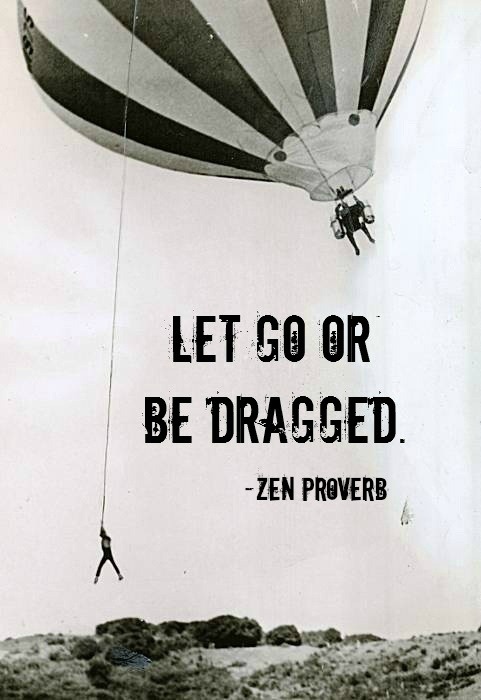
Letting Go (or be dragged)
They say that in India there is a particularly clever way of catching monkeys. As the story goes,
hunters will cut a hole in a coconut that is just big enough for a monkey to put its hand through. Then they will drill two smaller holes in the other end, pass a wire through, and secure the coconut to the base of a tree. Then they put a banana inside the coconut and hide. The monkey comes down, puts his hand in and takes hold of the banana. The hole is crafted so that the open hand can go in but the fist cannot get out. All the monkey has to do to be free is to let go of the banana. But it seems most monkeys don’t let go. Often our minds get us caught in very much the same way in spite of all our intelligence. Hence the term “monkey mind” which refers to the agitated, easily distracted and incessantly moving behavior of ordinary human consciousness.

In the meditation practice we intentionally put aside the tendency to elevate some aspects of our experience and to reject others. Instead we just let our experience be what it is and practice observing it from moment to moment. Letting go is a way of letting things be, of accepting things as they are.


Wednesday, March 4, 2015

The Tiny House Movement: A Generative Practice

The Tiny House movement is getting at the human need to live with what is important, removing the excess that pollutes the cosmos and our lives. It is a wonderful evidence of a generative process of preventing 1) overextension of resources which consumerism promotes and 2) rejection for those who have fixed incomes. It helps middle-aged persons/couples to follow the natural process living in a way that promotes caring and giving (vs. consuming) in a responsible manner that benefits one’s community and impacts in a small way the globe ecologically.

Saturday, February 14, 2015

Health Insurance Provide Considers Providing Coverage for Mindfulness Strategies

Health insurance provider making waves and considers providing coverage for mindfulness strategies for certain patients. 


According to Jon Kabat-Zinn, mindfulness means “paying attention in a particular way, on purpose, in the present moment, non-judgementally.” Kabat-Zinn is Professor of Medicine Emeritus and creator of the Stress Reduction Clinic and the Center for Mindfulness in Medicine, Health Care, and Society at the University of Massachusetts Medical School.

Read more: http://www.digitaljournal.com/life/health/mindfulness-in-the-news/article/424657#ixzz3RlO03Kxf

Sunday, January 25, 2015

The Role of Courage in Human Flourishing


What is the role of courage in promoting human flourishing? Since ancient times courage has been considered a virtue to cultivate that with other virtues contributes overall to happiness (eudaimonia). Aristotle designated courage as the best state of character in relation to feelings of fear and daring. As a mean good, the state of excess is foolhardiness (over-boldness) and the state of deficiency is cowardice (timidity, fearfulness). Aristotle outlined five types of courage as they play out in endurance of various dangers in society or one's context. There is "civic" courage which is based on a sense of shame; there is "military" or experienced courage, which is based on experience and knowledge of coping with them; another rests on "inexperience and ignorance", the kind that make children play with snakes; there is "expression of hope" which is based on one's previous success(es); and lastly "irrational passion" that may emerge because one is made bold by pain or frustration, e.g., love or rage. (Aristotle, The Eudemian Ethics)

The idea of valor, akin to courage, suggests engagement that is thoughtful in order to not shrink from threat, challenge, pain, or difficulty. While valor is more than bravery during physical threat, it expands to intellectual or emotional stances that are unpopular, difficult, or dangerous. It encompasses the capacity to uncouple the emotional and behavioral components of fear, to resist the urge to flee and face (distancing, isolation) the fearful situation.

Brené Brown, who has conducted important work with human vulnerability and shame, exhorts,
Rather than deny our vulnerability, we lean into both the beauty and agony of our shared humanity. Choosing courage does not mean that we’re unafraid, it means that we are brave enough to love despite the fear and uncertainty. . . When confronted with news of a stranger’s unimaginable pain – a suicide, an overdose, a protest for justice and basic dignity – we have two choices: We can choose to respond from fear or we can choose courage.

Brown provides five applicable examples of how to apply courage in our lives to promote whole-heartedness: 1. Asking for what you need, 2. Speaking your truth, 3. Owning your story, 4. Setting boundaries, 5. Reaching out for support.

We glean from the ancient to contemporary applications of the use the courage that its use for good should be  voluntary and not coerced action. It should involve judgment, i.e., some understanding of the risk and an acceptance of the consequences. At some level, a courageous person should have a disposition to take risks, yet must also overcome a tendency to take unconsidered risks. There is the awareness with courage that it requires the presence of danger, loss, risk, or potential injury. Earl Shelp “Without a sense of danger, risk, or vulnerability, there is no bravery in an act. Bravery is valuable because it allows people to dampen their immediate response to danger and evaluate the appropriate course of action. Bravery involves the mastery of fear.”

Courage is a necessary virtue or element of human capacity to face difficult challenges that are related to the relationships and circumstance that evoke fear and threat in and around us. In the face of challenges we can cower and be less human gravitating to our pseudo-self, or we can choose and develop with our sold (authentic) self the strength to name and tame the emotions of fear and dread and thus mobilize resources to help calm and act in a manner that achieves a higher good.

Sources:
Aristotle, The Eudemina Ethics, Transl. Anthony Kenny. New York: Oxford University Press, 2011.
Brené Brown, Daring Greatly: How the Courage to Be Vulnerable Transforms the Way We Live, Love, Parent and Lead. New York: Penguin Group, 2012)
Earl W. Shelp, “Courage: A Neglected Virtue in the Patient-Physician Relationship.” Social Science and Medicine, 18 (1984), 351–360.

Thursday, December 25, 2014

Let Your Life Speak: Finding the Deep Gladness that Meets the World's Deep Need

67862Parker Palmer in Let Your Life Speak invites the reader to consider and to follow deeply one's identity or sense of "calling" via the telling of his own story and with an illumination of various thoughts, texts, and poetry that support the premise that genuine vocation joins self and service. Detecting, pursuing and actualizing such vocation can become "the place where your deep gladness meets the worlds's deep need" (quoting F Buechner). Palmer is not unrealistic showing that such of life pursuit does not come without a "journey into darkness", for he interprets the path of vocational discovery (genuine sense of "calling") via his own human experience of movements out of incompatible places of employment (trial and error perhaps) and depression (deep spiritual/psychological experiences that require support). He takes on the American myth (e.g., consumerism) with a simple but elegant metaphor of the ecology of life and draws out the human dimension of "spirituality" as an often missing component that is antithetical to the common "power of positive thinking." Like a plant the spiritual journey that finds authentic vocation "will turn inward and downward toward the hardest realities of our lives, rather than outward and upward toward abstraction, idealization, and exhortation." In the end, which is only the start, we may discover in the words of Robert Frost  ("Two Tramps in Mud Time"),  

      My object in living is to unite
      My avocation and my vocation
      As my two eyes make one in sight.
      Only where love and need are one,
      And the work is play for mortal stakes,
      Is the deed ever really done
      For heaven and the future’s sakes.


Sunday, August 10, 2014

Character Strengths and Virtues: A Handbook and Classification


Finally, a handbook and classification of positive attributes (strengths, virtues) from years of work and research in "positive" psychology that capture the human being in a living, dynamic tension between inherent brokenness and a capacity to flourish. Practitioners have had to work too long with just the DSM-IV (now V) as a primary set of "labels" to describe our clients while having to advocate for their strengths among the naysayers surrounding client cases. Character Strengths and Virtues: A Handbook and Classification is founded on ancient roots of virtue ethics, an array of universal virtues that cross religious traditions,  and growing research and evidence-based practices which have evolved from positive psychology; e.g., developmental schemas, resilience factors, strengths-based perspective.  


This text will now be a primary source at my disposal to support engagement with clients, exploration among clients and to help clients identify their signature strengths by which to grow, work at change, and to flourish when many around them are stuck in the mud, wagging their heads in apathy.

Christopher Peterson & Martin E. P. Seligman, Character Strengths and Virtues: A Handbook and Classification, Oxford University Press, 2004. 

Friday, February 14, 2014

Demystifying Love

Demystifying love is a needed practice throughout life if we are to break through the seasonal and developmental grinds that bear down on the very nature of relationships.

From Demystifying Love: Plain Talk for the Mental Health Professional, Stephen B. Levine. New York: Routledge, 2007

Here are some nouns of love that help begin this process:
  •     An Idealized Ambition
  •     An Arrangement--a deal
  •     An attachment
  •     Moral commitment
  •     Management process
  •     A force of nature
  •     An illusion
  •     A stop sign

      Here are some diverse verbs of Love.
  •     Love evolves
  •     Falling in love
  •     Being-in-love
  •     Staying in love
Here are some concepts about staying in and sustaining love:
  •     Being genuine
  •     Overcoming narcissism
  •     Negotiation


“LOVE is mutuality of devotion forever subduing the antagonisms inherent in divided function.” - Erick Erickson

Below is a general taxonomy of love in relationships (thinking tool)